
Keep your best people. Raise the bar.
Iris™ shows you who’s carrying the company, who needs help and where the blind spots are, while there’s still time to act. It can, because every employee has an AI chief of staff and every manager has a coach.
Our cloud, yours or on-premises · Encrypted per person · Never used to train models
Which teams are the force multipliers?
- Multiplying24
- Steady65
- Diminishing15
Impact = deliver + lift others, at a pace people can sustain. Read from each team’s alignment and where it’s heading, the load it carries, and how much of the org’s work runs through its manager.
One system, three layers.
Each layer runs on the one below it. What Ari learns running each person’s day is what coaches their manager, and what Iris reads. No surveys, no forms.
- 1For everyoneAn AI chief of staffRuns each person’s day, works with everyone else’s, and knows who it’s working for.
- 2For every managerA coach1:1s, status, the weekly reflection and the team’s pulse: prepared, written and coached.
- 3For leadershipOrg insightsIris shows how your company actually works together, not how the org chart says it does.
An AI chief of staff for every employee. Multiplayer.
Each person gets their own Ari. It runs their day from the morning briefing to the overnight review, and works with the people around them, and their Aris.
- Knows the person, not just the tasks
Each colleague’s profile and communication style: how they think, what they’re strong at and how they like to work. So Ari helps two people work together, not just one person get through a list.
- Private by architecture
What each person tells their Ari is encrypted with a key unique to them. Leaders see what it adds up to, never the words. In our cloud, yours, or on-premises.
- Where everything else comes from
The 1:1 prep, the status update and the weekly reflection start here, and so does every signal Iris reads. Nobody fills in a form.
- Finds a time that works on everyone’s calendar
- Reminds a teammate, or a whole channel, for you
- Works as the team’s agent in Slack and Teams channels and group chats
- Knows each colleague’s profile and communication style before you meet
- Turns your day into a short post for your team
Routines
Your day with Ari, from morning to night: what Ari does for you, and what else it could take off your plate.
Morning
5–11 AM9 AM
- On:Morning briefingStart the day knowing what needs you.Slack · Weekdays, when something matters
Through the day
11 AM–4 PM- Before each meetingOn:Meeting prepWalk into every meeting already briefed.DM, 10 minutes before
- In your meetingsOn:Meeting notesAri joins, takes notes, and sends them after.Joins automatically
- After meetingsOn:Follow-upsAction items become todos, and close when they’re done.Closes them when they’re done
- When email needs youOn:Email heads-upsHear about the email that needs you, without watching your inbox.At most once a day
Evening
4–9 PM5 PM
- On:End-of-day wrap-upClose the day with what moved and what’s still open.Slack · Weekdays, when something matters
8 PM
- Idea:Calendar managerTomorrow’s focus time and lunch, protected tonight.
Overnight
9 PM–5 AM- WeeknightsOn:Journal and reviewAri goes over the day’s email, meetings and messages, writes it up in your journal, and catches what slipped.
4 AM
- Idea:Mailbox cleanupWake up to an inbox that’s already sorted.
Through the week
- WeekendsOn:Weekly reflectionA look back at your week: what you got done and what’s next.
- MondaysIdea:Weekend catch-upStart Monday knowing what happened over the weekend.
A coach for every manager.
Most managers were promoted for being good at something else. Ari prepares their 1:1s, writes the status from the work, reads the team’s pulse, and coaches them through the conversations that matter.
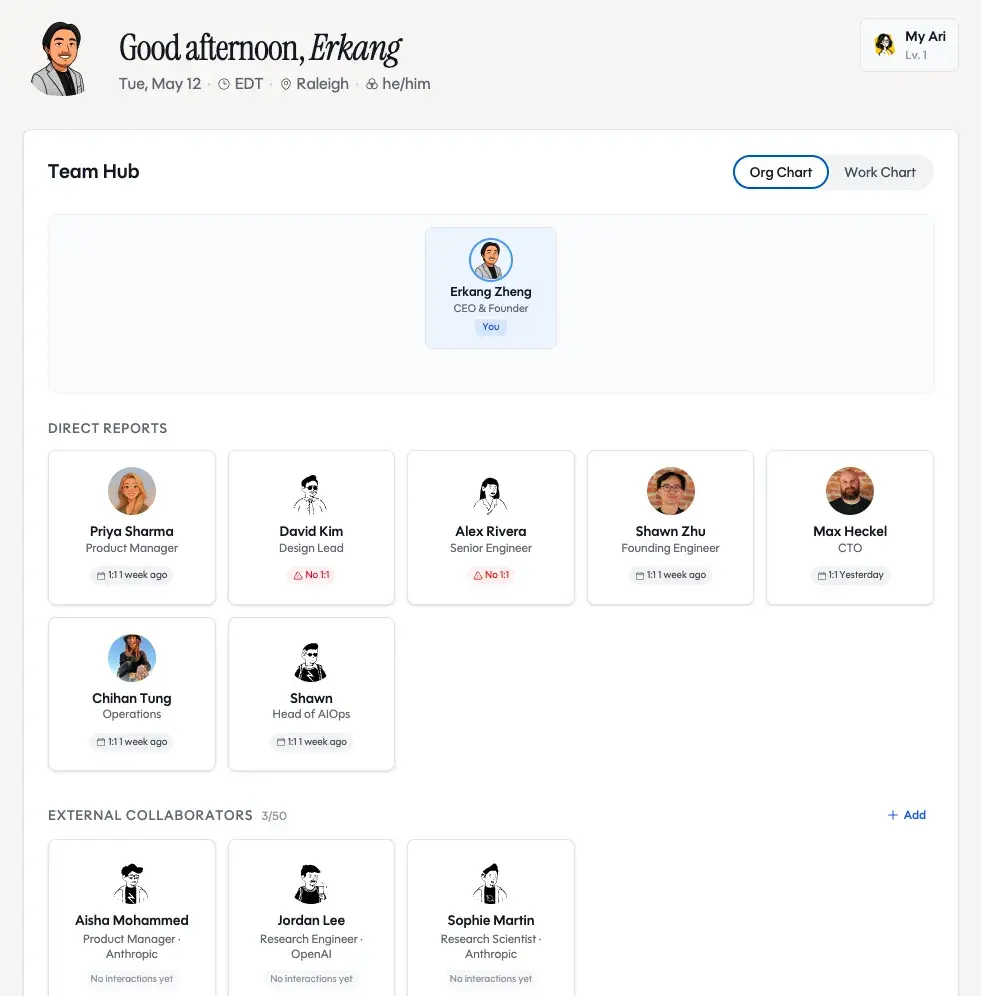
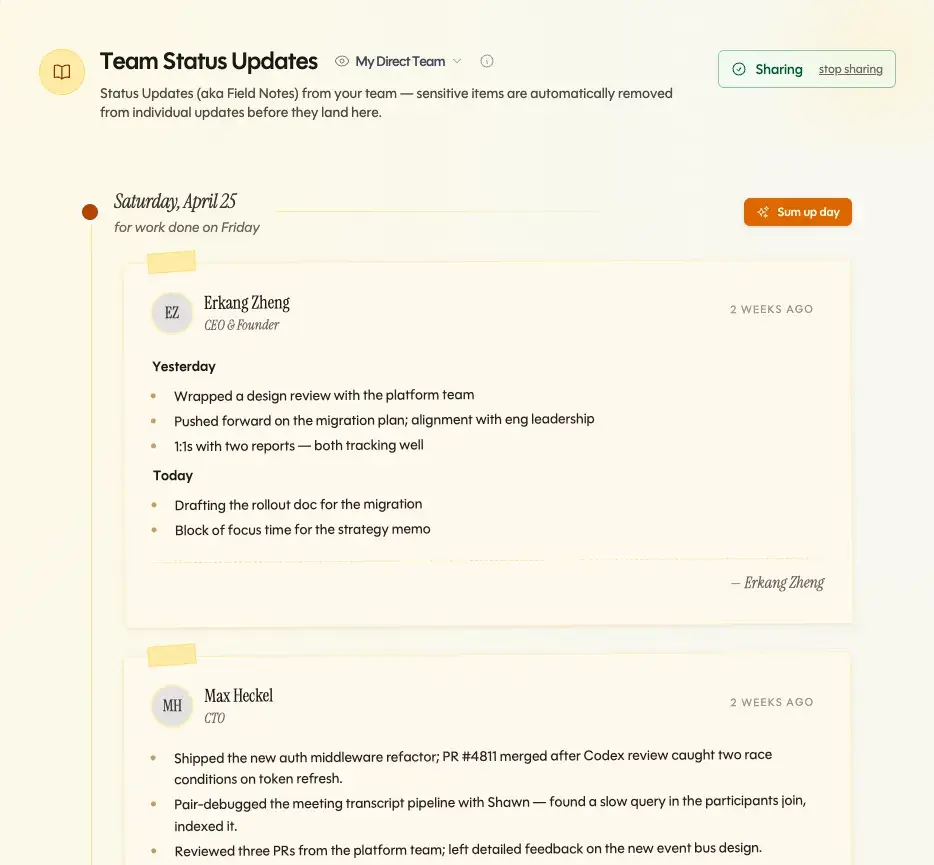

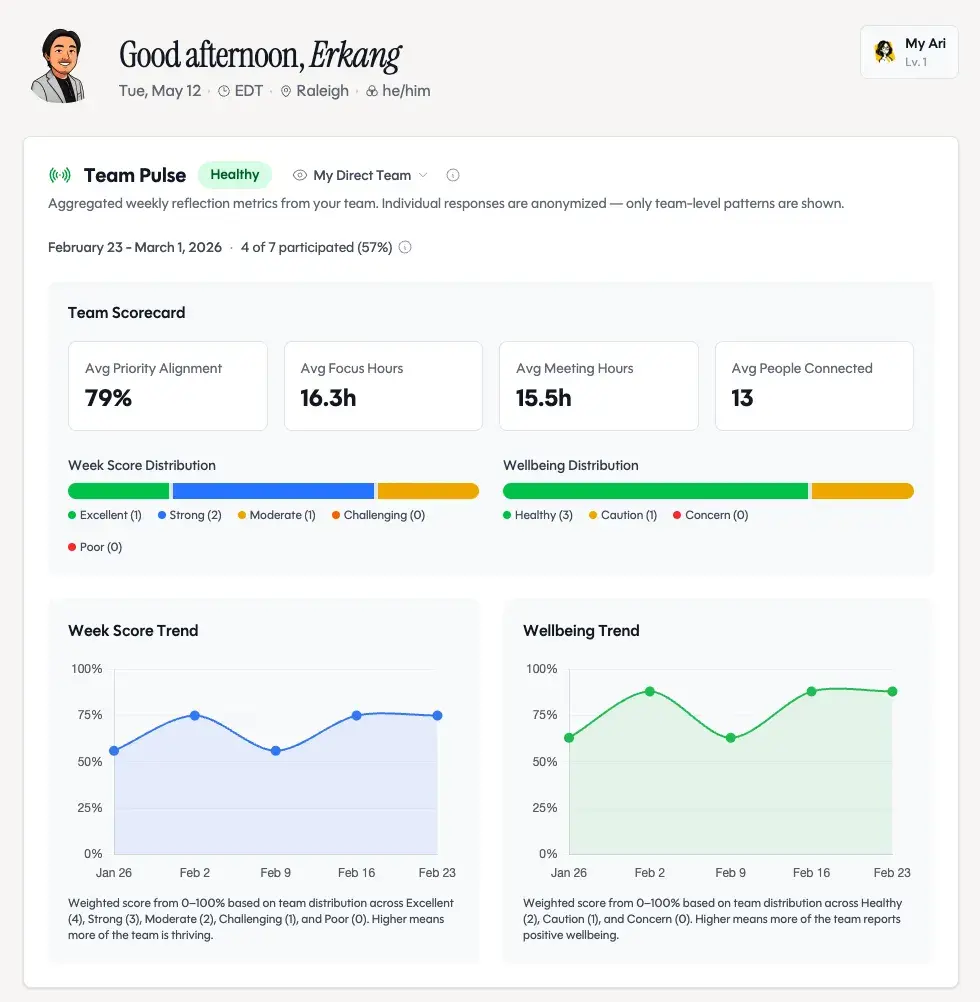
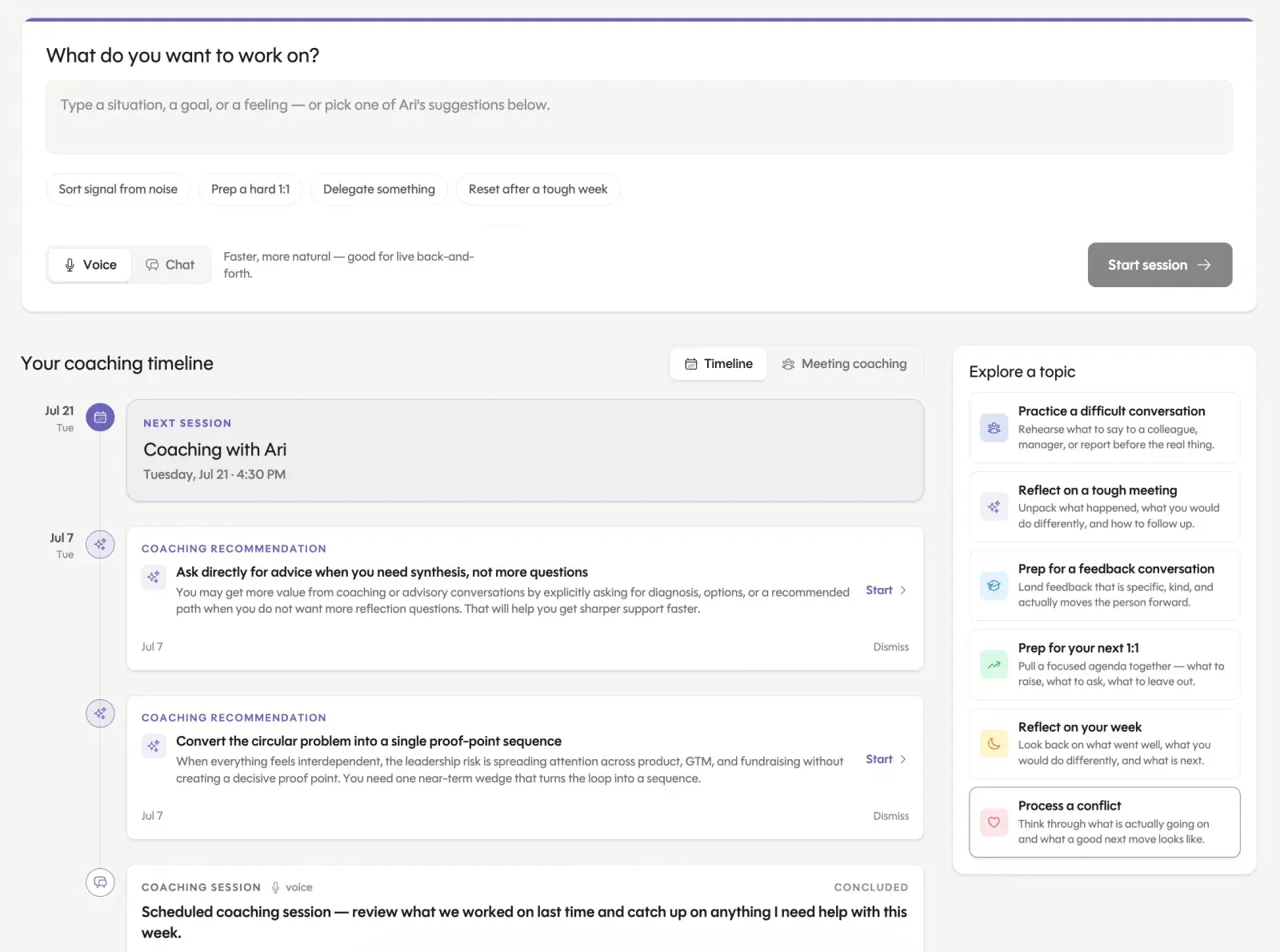
Every 1:1, prepared. Then coached.
Who’s due one, and who hasn’t had one. A shared agenda and Ari’s prep before it; after it, private coaching for both people, each on their own side of the conversation.
How your company actually works, not how the org chart says it does.
Iris maps who really works with whom: organizational network analysis (ONA), every week, with no survey. Then it lays your priorities, the load people carry and how their weeks are going over the map.
- Product
- Platform
- Sales
- Operations
- Finance
On paper
Who reports to whom. Tidy, and only half the story.
Signals to look into, not verdicts.
About your people and about the work, each with the people involved and the reason it was raised.
- Lifting others
- Worth a conversation
- Spinning wheels
- Carrying too much
- Gone quiet
- Drifting from the priorities
- In the wrong seat for their strengths
- Possible overlap
- Dates slipping
- Key-person risk
- No recent activity
Every signal, and when Iris reads itWhat each one means, the nightly, weekly and monthly rhythm, and the tools it replaces
- Lifting others
The people the rest of the team does better around.
- Worth a conversation
Something in their weeks to ask them about, not a conclusion.
- Spinning wheels
Real effort, two weeks running, and the work keeps coming back.
- Carrying too much
Far more than their peers, and their reflections say it’s costing them.
- Gone quiet
Doing much less than they used to, with no time off on the calendar.
- Drifting from the priorities
Their work has been sliding away from the strategy all quarter.
- In the wrong seat for their strengths
What they’re strong at points somewhere their seat doesn’t ask for.
- Two teams are building route optimization
Possible overlap · Last-mile routing engine and Route optimization service describe the same solver, under different initiatives, with no shared members.
- Metro hub buildout has moved its date three times
Dates slipping · The launch milestone has slipped 41 days since it was set.
- Dispatch copilot runs through one person
Key-person risk · One member owns every open milestone on the project.
- EMEA carrier network has gone quiet
No recent activity · No updates, meetings or milestone changes in 24 days.
- NightlyEvery project, re-read
Status rewritten from reflections, meeting notes and task activity. A risk shows once it has held for three days, so a bad afternoon isn’t an alarm.
- MondaysThe Org Pulse report
Priority alignment, focus and meeting hours, and people connected across the org, with the patterns, risks and wins behind them.
- WeeklyTwo moves worth considering
Where leadership could lean in, read against your strategy and market. Suggestions to weigh, not verdicts.
- MonthlyA review of every initiative
Each metric against the pace it needs to hit its date, then risks, blindspots, drift and dependencies — each marked new, persisting or escalating since last time.
The tools you stitch together today, each holding a slice:
The framework behind it: want, say, doWhat you want people to do, what they say they’re doing, and what they’re actually doing
- 1 · Want
What you want people to do
Your goals and initiatives, and each person’s role, responsibilities and priorities, connected to them.
- 2 · Say
What they say they’re doing
Status updates, check-ins and the self-review. Written by hand, a week late, and usually green.
- 3 · Do · read from the work
What they’re actually doing
Read from the work itself: the meetings, the messages, the projects, and whether the work landed.
Good management starts with understanding your people. It has always run on the first two; Iris reads the third, and shows you where the three don’t line up. Where they do, you know who’s carrying the company. Where they don’t, you know where to look.
What regrettable churn, disengagement and misalignment cost a 500-person company, before the deals lost and the customers who leave when priorities drift. Iris is how you see it coming.
See the math, and the stories behind itA 500-person company · $50M payroll
- $2.9M
Regrettable churn
39 people a year you didn’t want to lose, at ~$75K each to recruit, hire, onboard and ramp a replacement
- $9.6M
Disengagement & management drag
2 in 3 people not engaged at work, and managers’ time lost to low-value work
- $4.3M
Misalignment
Hours a week lost to duplicated work and unclear priorities, and 11¢ of every project dollar wasted
A modeled estimate, not a measured loss · Gallup · SHRM · Work Institute · Bain · Asana · PMI · How we got there
The star who left.
They took an offer 40% higher. You’d have matched it, and promoted them six months ago, if you’d seen it coming.
The director who went quiet.
Months of unanswered messages while the team carried the work. When they finally left, ten people said “thank God.”
The 65-hour week that never lands.
Committed, in every meeting, always busy, and the work keeps coming back. Effort and outcome aren’t the same thing.
Private by architecture. Fair by design.
Built by a team that spent its career in cybersecurity, for the security review you’re already picturing, and for the people team’s questions after it.
- Our cloud, yours, or on-premises
Run it in Ariso’s cloud, or inside your own boundary, where your data doesn’t leave it.
- Encrypted per company and per person
Your keys are separate from every other company’s, and each person’s conversations are encrypted to them alone.
- One standard for everyone
Each person is read against their own role, goals and priorities. No favorites, no loudest voice.
- Outcome, not hours
Long hours on work that keeps coming back reads as spinning wheels, not as a top performer.
Who sees what, and the rest of the reviewWhat stays private, what leaders see, and how data comes in
- What people write stays theirs
Reflections and conversations with Ari are private. Leaders see what they add up to, never the words.
- Leaders see where to look
Iris shows admins the signal on each team and person: on the priorities or drifting, stretched or steady. “Under strain” comes from people’s own reflections, not their calendar.
- Everyone sees the line of sight
Every employee can see how their goals ladder up to the initiatives and the north star — the strategy isn’t a leadership secret.
- People see their own read
Everyone gets their own week, written up, every week. So the conversation about a rough patch happens early, when it’s still a small one.
- Standard integrations only
Data comes in through APIs and OAuth. No browser extension collects anything.
- Your own knowledge, connected
Glean, an in-house knowledge base or your own tools, connected over MCP.
SOC 2 · Google CASA · Never used to train models · Trust & security
Out of the box, or built with you.
Run it in our cloud and start right away, or deploy it in your own cloud or on-premises, tuned to your company. You choose what fits your security review, your systems and your pace.
In Ariso’s cloud
Ready to connect to the tools you already run, and to roll out team by team.
- Hosted on AWS in the US
- Encrypted per company and per person
- Google Workspace, Microsoft 365, Slack and Teams, over APIs and OAuth
- SOC 2 and Google CASA
For moving fast, with the review you’d give any SaaS tool.
In your cloud, or on-premises
Deployed inside your boundary, connected to your systems and tuned to your company.
- Your own cloud account, or your own servers
- Tuned to your roles, goals, values and review cycle
- Your knowledge connected over MCP: Glean, an in-house base, your tools
- Bring your own models, with your OpenAI or Anthropic keys
For when the data can’t leave your boundary, or the rollout has to fit how you work.
Whichever way you run it, we scope it and price it with you, on a call. Under 500 people? See Business pricing
How a rollout runsScope it, set it up, tune it, and plan the opt-in with your people team
- 01
Scope it together
The people questions that matter most to you, the systems that hold the signal, and who should see what.
- 02
Set it up where it runs
In our cloud or in yours, connected to the systems you already run.
- 03
Tune it to your company
Your roles, goals, values and review cycle, so a signal means what your leaders mean by it.
- 04
Plan the opt-in with your people team
Who sees what, how it’s explained, and which teams go first. You walk into your next review cycle with the evidence.
Questions, answered
What is Ariso Enterprise?
One system in three layers for companies of 500+: an AI chief of staff (Ari) for every employee, a coach for every manager, and org insights for leadership (Iris), which shows how the company actually works together. Each layer runs on the one below it, so there are no surveys and no forms to fill in.
What is organizational network analysis (ONA)?
ONA maps how people actually work together, as opposed to how the org chart says they do. Iris draws it from shared meetings, Slack threads and who emails whom (never what was said), and shows the hubs nobody drew, teams that reach the company through one person, teams working in isolation and duplicated work, with the priorities and the load people carry laid over it.
What is Iris?
Iris is Ariso’s view of the whole organization: the org chart drawn as rings, with the working ties bundled along it, read across a rolling 13 weeks for impact, alignment, load and execution. It raises signals to look into, such as Lifting others, Gone quiet or Carrying too much, never verdicts on anyone.
What does the AI chief of staff do for each employee?
Each person’s Ari runs their day: a morning briefing, prep before every meeting, notes in it, follow-ups after, an end-of-day wrap-up and an overnight review. It works for the whole team too: it finds a time on everyone’s calendar, reminds a teammate or a channel, works as the team’s agent in Slack and Teams channels and group chats, and knows each colleague’s profile and communication style.
Can Ariso run in our own cloud or on-premises?
Yes. Run it out of the box in Ariso’s cloud (AWS, in the US), or have it built with you in your own cloud account or on-premises, connected to your systems and tuned to your roles, goals and review cycle. You can connect your own knowledge over MCP and bring your own OpenAI or Anthropic keys.
Do managers or leaders see what employees tell Ari?
No. Each person’s conversations and reflections are encrypted with a key unique to them. Leaders see what the signals add up to, and the status people choose to share, never anyone’s words. Ariso never uses customer data to train models.
How is Ariso Enterprise priced?
Every deployment is scoped and priced with you on a call. For companies under 500 people, Ariso Business has published pricing.
- The CLEAR FrameworkWant, say and do: what a well-run organization looks like.
- Strategy executionIris on your initiatives: what’s on track, and who’s on it.
- Ari for managersA week of 1:1s, coaching and the team’s pulse, in full.
- Ari vs TownTwo multiplayer chiefs of staff, and where each one stops.
- Trust & securityEncryption, certifications and subprocessors, for your review.
Wouldn’t you rather know now?
Tell us about your company. We’ll show you the system on a call and scope it to your environment.